3D printing for jewellery: printers, castable resins and waxes
How each kind of jewellery 3D printer works, what castable resins and printed waxes are, and why burnout is where most printed models fail, with the checks a caster makes before casting a print.
A printed model is not jewellery yet. In most workshops it is a pattern: a copy of the piece in resin or wax that is invested in plaster-like investment, burned out of the mould and replaced by molten metal, exactly as a hand-carved wax would be in lost-wax casting. That is why the choice of printer and material is really a casting decision. This guide explains the printer types, the materials, and the burnout step where most printed patterns succeed or fail. For the overall path from design to finished piece, see our short guide to CAD and 3D printing.
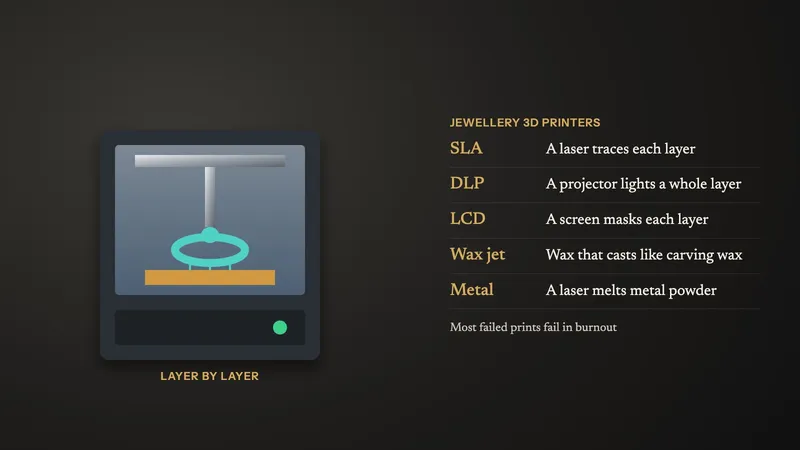
The printer families
Additive manufacturing is grouped into seven families by the standards body ASTM. Three matter in jewellery:
- Vat photopolymerisation (resin printers): a platform sits in a vat of liquid resin that hardens where light falls on it, one thin layer at a time.
- Material jetting (wax printers): a print head jets tiny droplets of material, much like an inkjet printer, building the model layer by layer with a separate support material.
- Powder bed fusion (direct metal printers): a laser melts fine metal powder layer by layer, producing a metal piece with no casting at all.
| Type | How each layer is made | Typical use |
|---|---|---|
| Laser SLA | A laser traces the shape point by point, steered by mirrors | Fine, smooth patterns; one or many pieces per build |
| DLP | A projector lights the whole layer at once through a chip of tiny mirrors | Fast builds of many small pieces |
| LCD (MSLA) | An LED backlight shines through an LCD screen that masks the layer | Low-cost entry into resin printing; detail depends on the screen's pixels |
| Wax jetting | A print head jets wax droplets, with a support wax dissolved after | Production patterns that cast like traditional wax |
| Metal powder bed fusion | A laser melts gold, platinum or silver powder | Shapes that cannot be cast; high cost per piece |
Resin printers typically build in layers of 25 to 100 micrometres, and wax-jetting machines in layers of a few tens of micrometres. Finer layers mean smoother surfaces and longer builds. With laser printers, the time depends mostly on how much there is to trace; with DLP and LCD printers, each layer takes the same time however many pieces are on the platform, which is why they suit full build plates of small parts.
The materials
Castable resin is a light-cured plastic designed to burn out of a mould. Unlike wax, it does not melt and drain away: it has to be decomposed by heat, and it expands as it heats. If the burnout is too fast, the expanding pattern can crack the investment; if it is incomplete, ash stays in the mould and fine details go missing in the metal.
Wax-filled resin (often sold as castable wax resin) mixes wax into the resin. Part of the wax melts out early in the burnout, which leaves room for the rest to expand and lowers the risk of cracking: resin makers design it to cast more like wax than plain castable resin does.
Printed wax from a wax-jetting printer behaves like the carved and injected wax that casting investments were designed for: it melts out and burns clean. It is more fragile to handle and the printers cost more, which is why many workshops use resin for samples and wax for production.
Other resins are not for casting: high-temperature resins for printing masters to make rubber moulds, and tough or flexible resins for try-on samples, fitting stones and client approval.
From the printer to the flask
Before it can be cast, a resin print is washed (usually in alcohol) to remove uncured liquid resin, dried thoroughly, and, where the resin maker asks for it, post-cured under UV light. Supports are clipped off and their marks cleaned up. Wet or tacky prints cause problems later, so only completely dry patterns go on the tree.
How the model sits on the build platform matters too. Supports leave small marks, so they go where finishing is easy, never on a prong tip or a setting seat. Large flat areas facing the platform can warp.
Burnout and casting: where prints succeed or fail
Resin patterns need a burnout written for them, not the one used for wax. Resin makers publish their own schedules, and the investment maker's instructions apply as well. The general principles are the same everywhere:
- Slow, staged heating, with holds that let the pattern soften and escape before the investment is stressed. Thick or large patterns need slower schedules.
- A high enough final temperature to burn out completely: one resin maker states at least 732 °C for its direct-casting resins, before the flask is brought down to the casting temperature of the metal.
- Air: the resin needs oxygen to burn. A crowded kiln burns out worse than one with a few flasks.
- The right investment: follow the resin maker's advice. One maker names a standard gypsum-bonded jewellery investment for its wax-filled resins, and a stronger phosphate-bonded investment for difficult designs.
Design helps as well: hollowing thick sections, keeping trees small, leaving more investment between printed pieces than between waxes, putting heavy parts low on the tree, and sizing sprues to the part they feed.
| What you see | Likely cause |
|---|---|
| Missing fine details, rough patches | Ash left in the mould: incomplete burnout |
| Fins or flashing across the piece | Investment cracked as the pattern expanded |
| Investment inside a hollow piece | Vent holes not sealed before investing |
| Bubbles on the metal surface | Investment poured too fast or not degassed |
| Distorted or warped shape | Pattern printed or stored badly, or not fully cured |
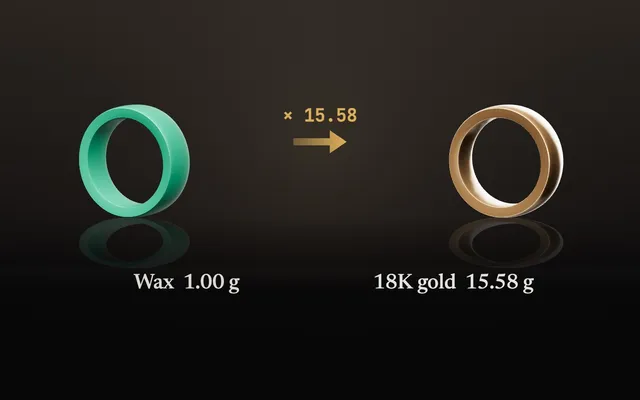
For the casting faults that are not specific to printing, see our guide to casting porosity, gas, shrinkage and investment. Printed resin is denser than wax, so a given model weighs differently; our casting weight calculator takes the pattern material into account.
Printing directly in metal
Powder bed fusion prints the piece itself in gold, platinum or silver, with no pattern and no mould. It can make shapes no caster can: closed hollow forms, interlocking parts, lattices. The difficulties are real. Gold, silver and platinum reflect much of the laser light and conduct heat away fast, which makes fully dense parts hard to achieve; current research works on special alloys, coated powders and green or blue lasers. The machines, the powder and its recovery make each piece expensive, so direct metal printing is used by a small number of specialist manufacturers rather than in everyday workshops.
Printing in-house or using a service
A printer is only the start: the workshop also needs washing and curing equipment, a kiln with good airflow, and time to tune burnout schedules. Many designers and small workshops send files to a print-and-cast service instead. Either way, ask the same questions:
- Which printer and which material will print the file, and in what layer height?
- Minimum wall, prong and shank thicknesses for that material and metal.
- Whether the service casts its own prints, and whether the price includes cleaning up support marks.
- A printed or cast sample before any production run.
Facts last checked: 24 October 2026. Burnout temperatures and schedules differ between materials: always follow the resin and investment makers' current instructions.
Share this article
Sources
- Loughborough University Additive Manufacturing Research Group: the seven categories of additive manufacturing (ASTM F42)
- Loughborough University AMRG: vat photopolymerisation
- Loughborough University AMRG: material jetting
- Formlabs: guide to resin printers, SLA, DLP, MSLA and LCD (manufacturer's guide)
- Formlabs: introduction to casting with Formlabs resins (burnout, investment, faults; manufacturer's white paper)
- Eric Paul Marvets: Resin Casting, a Collection of Hypotheses (Santa Fe Symposium, 2018)
- Frank Cooper: Sintering and Additive Manufacturing, the New Paradigm for the Jewelry Manufacturer (Santa Fe Symposium, 2012)
- Thangamani and others: A comprehensive review of laser powder bed fusion in jewelry (Metals 14, 897, 2024)
- Shele Letwin: Mill or 3D printer? (Jewellery Business, 2013)