Gold karats: fineness, marks and alloys by country
What 9K, 14K, 18K, 22K and Thai 96.5% gold really contain, which fineness marks each market expects, and why colour and alloy matter as much as karat.
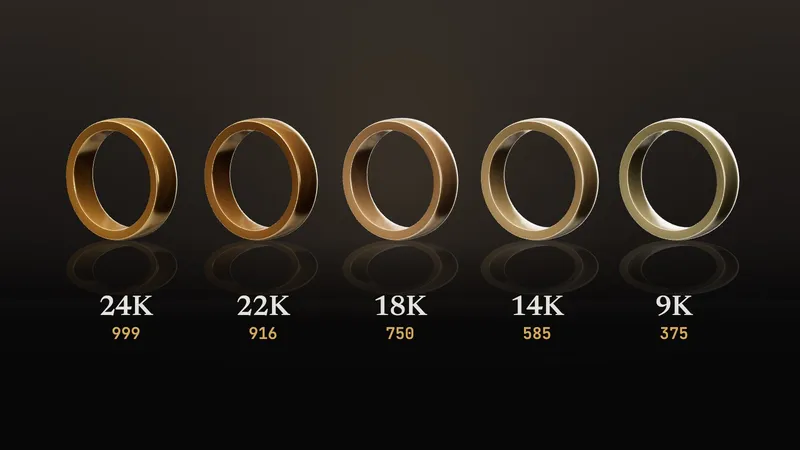
Karat tells you how much of an alloy is pure gold, in parts out of 24. Fineness tells you the same thing in parts per thousand. 18 karat means 18 parts out of 24 are gold: 18 ÷ 24 = 0.750, so 18K is stamped 750. The rest of the alloy is usually silver, copper, zinc, palladium or nickel, and that part decides the colour, hardness and working properties.
The common standards
| Karat | Fineness mark | Gold content | Where it is common |
|---|---|---|---|
| 24K | 999 | 99.9% | Bullion, investment jewellery (India marks 24K as 995) |
| Thai gold | 965 | 96.5% | Thailand: standard gold sold by baht weight |
| 22K | 916 | 91.6% | India, Middle East, Southeast Asia, UK |
| 21K | 875 | 87.5% | Middle East |
| 18K | 750 | 75.0% | International fine jewellery |
| 14K | 585 | 58.5% | USA, Europe, India |
| 10K | 417 | 41.7% | USA |
| 9K | 375 | 37.5% | UK, Ireland, Australia |
| 8K | 333 | 33.3% | Germany and some other countries |
14K is stamped 585, a little above 583 (14 ÷ 24 = 0.583), because the hallmarking standard was set at 585. The other marks follow the arithmetic: 18K is exactly 750, 9K exactly 375, and 22K (916.7) is marked 916. Our karat and fineness converter uses these standard marks.
What each market expects
- United Kingdom: hallmarking by an independent Assay Office is compulsory for gold items over 1 gram (silver over 7.78 g, platinum over 0.5 g, palladium over 1 g). 9K (375) is the lowest gold standard that can be hallmarked.
- European Union: there is no single EU hallmarking law. Some countries require independent hallmarks, others allow the maker's own stamp. Countries in the International Hallmarking Convention recognise the Common Control Mark (CCM).
- United States: no compulsory hallmarking, but the FTC Jewelry Guides apply and a karat stamp must be accurate. Under the National Gold and Silver Stamping Act, a piece with a quality mark must also carry the registered trademark of the company that stands behind it. Since 2018, gold below 10K may be described as gold if the karat is stated.
- India: BIS hallmarking is compulsory for gold jewellery in most districts, with a six-character HUID code on each piece. Standard grades include 9K (compulsory since July 2025), 14K, 18K, 20K, 22K, 23K and 24K. Pieces under 2 g are exempt.
- Thailand: traditional gold shops sell 96.5% gold by weight in baht (15.16 g for jewellery). Export jewellery is usually made in 9K to 18K to suit the buyer's market.
- Middle East: 21K and 22K dominate in the souks; 18K for diamond jewellery.
- China and Hong Kong: much gold jewellery is sold as pure gold (zu jin, at least 990), next to 18K for set jewellery.
Rules change and have exceptions. Before you ship to a new market, check the current hallmarking law with the local assay office or your buyer.
Colour comes from the other metals
- Yellow gold: gold with silver and copper in balance.
- Rose and red gold: more copper. Harder, and some red alloys need care when casting.
- White gold: gold whitened with palladium or nickel, usually rhodium plated. Nickel white gold is harder and cheaper but causes allergies in some people; in the EU, nickel release from jewellery that touches the skin is limited by law (REACH). For European buyers, palladium white gold is the safer choice.
- Green gold: gold with a high share of silver.
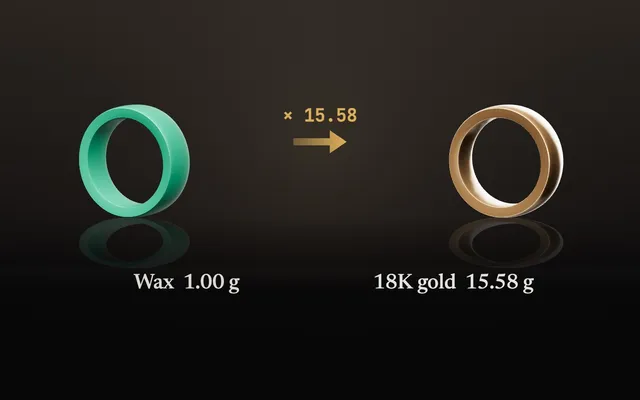
Alloys of the same karat have different densities, so the same model weighs more in 18K palladium white than in 18K rose. Our metal weight calculator lists 47 alloys, including 9K, Thai 96.5%, Argentium and platinum 900.
Try it yourself
- Alloying calculator →Fine metal and alloy for a new karat, a karat change or scrap, checked against tolerance
- Precious metal colours, measured →Gold colours by karat, with platinum, palladium and silver, from measured data
- Hallmark decoder →Build a hallmark punch by punch, or decode a stamp you have found
- Plated, filled or solid? →Flashed, plated, vermeil, rolled, filled or solid: how much gold each holds
Share this article
Sources
- Assay Office London: Hallmarking guide (exemption weights, standards)
- International Hallmarking Convention: Common Control Mark
- US FTC Jewelry Guides, 16 CFR Part 23 (gold content and quality marks)
- National Gold and Silver Stamping Act, 15 U.S.C. chapter 8
- Bureau of Indian Standards: Hallmarking overview (HUID, grades)
Facts last checked on 11 October 2026.