Casting porosity: telling gas, shrinkage and investment apart
How to recognise the main kinds of porosity in jewellery castings, what usually causes each, and the checks and changes that prevent them.
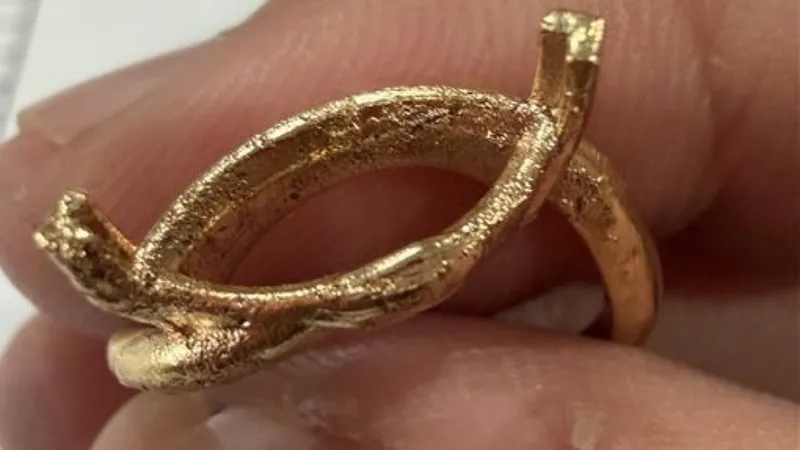
Porosity is one of the most common reasons castings are reworked or rejected, and it often shows only at final polish. Different kinds of porosity have different causes, so naming the type correctly is the first step. Appearance is a strong clue but not proof, and more than one cause can act at once.
| Type | What it looks like | Where it appears | Usual causes |
|---|---|---|---|
| Gas porosity | Smooth-walled, nearly round cavities; small ones in clusters, larger ones on their own | Anywhere; often just below the surface | Gas picked up by the melt (oxygen, hydrogen, moisture), poor burnout, metal too hot, gas from the investment |
| Shrinkage porosity | Irregular, spongy cavities with rough, branching (dendritic) walls | Sections that solidify last: thick areas, sprue junctions | Metal is not fed while it solidifies: sprues too small or in the wrong place, abrupt thick-to-thin changes, metal too cold |
| Micro-shrinkage | Very fine pores between the metal crystals | Spread through the section | Alloy-dependent solidification; some alloys are more prone than others |
| Investment-related | Rough surface, sometimes a glassy layer, with gas pores beneath | Hot spots: sprues, thick sections, sharp edges | Investment breaking down or reacting with very hot metal |
Shrinkage porosity
Metal shrinks as it solidifies: Eddie Bell's World Gold Council guide puts the loss for jewellery alloys at about 5 to 6% of volume. If the sprue freezes before the part it feeds, that lost volume becomes porosity. The aim is directional solidification: the part freezes from its far end back towards the sprue and button, which stay liquid longest.
- Attach the feed sprue to the thickest section of the piece.
- Use round sprues large enough to stay liquid longer than the part.
- Avoid thin sections that freeze early and cut off feeding to thicker areas beyond them.
- Cast hot enough: research on platinum showed much more shrinkage porosity, especially at the sprue, when the melt was too cold.
- Leave enough space between pieces on the tree.
Gas porosity
- Melt under a protective atmosphere (argon or vacuum) where possible, and keep crucibles and tools dry.
- Limit recycled metal: alloying elements that protect against oxygen, such as zinc, burn off with each re-melt.
- Complete the burnout so no wax residue or carbon remains.
- Do not overheat the metal.
With gypsum-bonded (calcium sulphate) investments there is a specific risk: research presented at the Santa Fe Symposium showed that the investment can decompose close to the casting temperature of some gold alloys, releasing sulphur dioxide that causes gas porosity. Higher-melting alloys need investments designed for them.
Investment-related defects
Where very hot metal meets the mould at sprues, thick sections and sharp edges, the investment can soften or react. The result is a rough surface, sometimes with a glassy layer of molten investment and gas pores just below it. This is the main limit for platinum and palladium casting, which need more stable investments designed for them and careful control of metal and flask temperature.
| Setting | Value | Source |
|---|---|---|
| Flask temperature, investment casting | 500–900 °C, depending on alloy, size and shape | fem research institute (Klotz et al., 2019) |
| Flask temperature, gold and silver | about 430–650 °C (800–1200 °F) | Romanoff |
| Flask temperature, platinum | about 870–900 °C (1600–1650 °F); 850 °C in the fem study | Romanoff; fem |
| Pouring temperature | about 80–105 °C above the melting point (+150–190 °F) | Romanoff |
| Superheat, platinum 950 | at least 100 °C above liquidus for Pt-Ru; 50–80 °C for Pt-Co | fem research institute |
These are starting points from published sources. Always follow the alloy and investment makers' data sheets for your materials.
When to ask a specialist
If porosity keeps returning, a metallurgical cross-section of a defective piece shows the pore walls clearly and is the most reliable way to tell gas from shrinkage. For platinum, hot isostatic pressing (HIP) can close internal micro-shrinkage pores and restore ductility.
Related: casting weight calculator, how casting weight is calculated and CAD and 3D printing for jewellery.
Share this article
Sources
- Donohue & Frye, Identification and correction of platinum casting defects (TechForm with Platinum Guild International, 1999), via Ganoksin
- Bell, The sprue system design (© World Gold Council), via Ganoksin
- Klotz, Heiss, Tiberto & Held, Investment casting of platinum group metals (fem; First Jewellery Materials Congress, London, 2019)
- Ingo, Chiozzini, Faccenda, Riccucci & Veroli, CaSO4-bonded investment for casting of gold-based alloys: thermal decomposition (Santa Fe Symposium, 1999)
- Romanoff: Porosity, the facts