Ring sizes: converting US, UK, EU and Japan
Why the same finger has four different sizes, how to convert between them without mistakes, and what to agree with your customer before production.
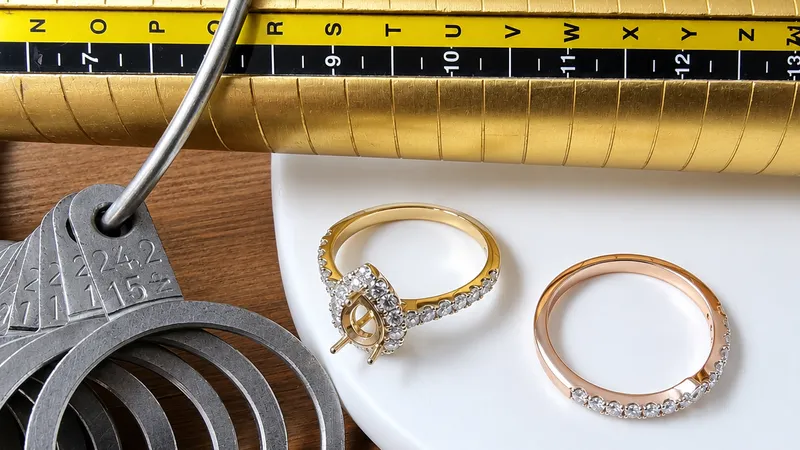
A customer in New York orders a size 7. Your workshop in Bangkok works in millimetres, your setter in Jaipur checks on a mandrel, and the retailer in London asks for an N½. All four can describe the same ring, but only if everyone converts the same way. Most remakes on international orders come from a size that was converted twice, rounded twice, or never confirmed.
Every system measures the same thing
All ring size systems describe the inside of the ring. They only differ in how they write it down:
- Europe (ISO 8653): the inside circumference in millimetres. Size 54 is a 54 mm circumference.
- US and Canada: numbers with quarter and half sizes. Each full size adds about 2.55 mm of circumference (0.032 inch of diameter).
- UK, Ireland and Australia: letters from A to Z, with half sizes. Each letter adds 1.25 mm of circumference.
- Japan: numbers that start at 13 mm inside diameter for size 1, adding about one third of a millimetre of diameter per size.
- Switzerland: the circumference minus 40, so EU 54 is Swiss 14.
Because every system can be turned into a circumference, the safest way to convert is always through millimetres: size to millimetres, then millimetres to the other size. Never convert US to UK using a second-hand chart that was itself converted from another chart.
| US / Canada | Circumference (mm) | Diameter (mm) | UK / Australia | EU (ISO) | Japan | Switzerland |
|---|---|---|---|---|---|---|
| 4 | 46.7 | 14.9 | H½ | 47 | 7 | 6.5 |
| 5 | 49.3 | 15.7 | J½ | 49 | 9 | 9.5 |
| 6 | 51.8 | 16.5 | L½ | 52 | 11 | 12 |
| 7 | 54.4 | 17.3 | N½ | 54 | 14 | 14.5 |
| 8 | 56.9 | 18.1 | P½ | 57 | 16 | 17 |
| 9 | 59.5 | 18.9 | R½ | 59 | 19 | 19.5 |
| 10 | 62.0 | 19.7 | T½ | 62 | 21 | 22 |
| 11 | 64.6 | 20.6 | V½ | 65 | 24 | 24.5 |
| 12 | 67.1 | 21.4 | X½ | 67 | 26 | 27 |
For any other size, use our ring size converter. It uses exactly the formulas above and also starts from a measurement in millimetres.
Where sizes go wrong
- Wide bands fit tighter. A 2 mm band and an 8 mm band in the same size do not feel the same. For bands wider than about 6 mm, many makers go up a quarter to half a size. Agree this with the customer; don't decide it silently.
- Mandrels differ. Two workshops' mandrels can disagree by a quarter size or more. If you work with a partner abroad, compare mandrels once using a ring with a measured inside diameter.
- Comfort fit and inner profiles change how a size feels. State the inner profile on the order.
- Rounding twice. Convert once, from the original size, and write the millimetre figure on the order.
- Resizing later. Eternity rings, channel-set bands, tension settings and some enamel or engraved designs cannot easily be resized. Get the size right before production.
What to put on the order
Write the size in the customer's own system and the inside diameter or circumference in millimetres, for example: US 7 (inside circumference 54.4 mm, diameter 17.3 mm). Add the band width and the inner profile. If the customer measured at home with a paper strip or string, ask for a second measurement with a plastic sizer, or send one; paper strips stretch and slip.
Try it yourself
Share this article
Sources
- ISO 8653:2016 Jewellery: ring-sizes, definition, measurement and designation
- GIA 4Cs: How to determine ring size, tips and ring size chart
Facts last checked on 11 October 2026.