Casting weight: calculating the metal from wax or resin
The one formula behind every casting weight chart, worked examples for gold, silver and platinum, and how much to add for sprues and the button.
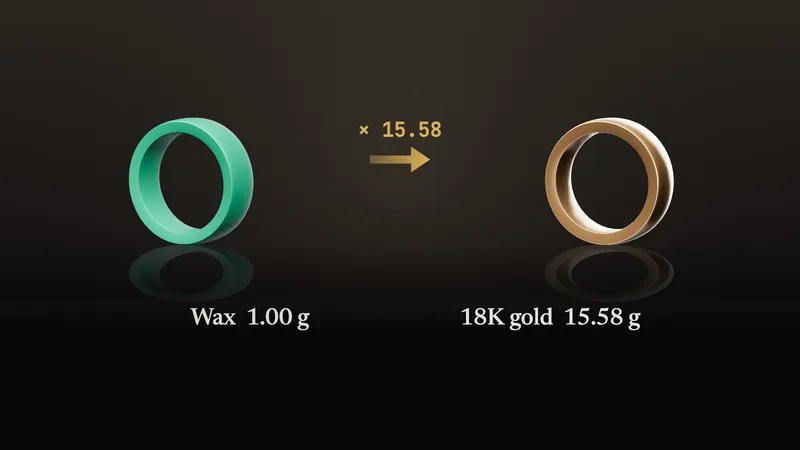
Before every casting someone has to answer a simple question: how much metal goes into the crucible? Too little and the flask is lost. Too much and expensive metal sits in the button. The answer comes from one formula.
The formula
A casting has the same volume as the model it replaces. Weight is volume times density, so:
metal weight = model weight × (metal density ÷ model density)
Injection and carving wax has a density close to 1.0 g/cm³, which is why the trade simply multiplies wax weight by the metal's density, its specific gravity. Castable 3D-printing resins are denser, around 1.18 g/cm³ for Formlabs Castable Wax resin after curing, so a resin model produces less metal per gram than wax. Check your resin's data sheet; brands differ.
| Metal | Density (g/cm³) | From 1 g of wax | From 1 g of resin (1.18) |
|---|---|---|---|
| Sterling silver 925 | 10.36 | 10.4 g | 8.8 g |
| 9K yellow gold | 11.20 | 11.2 g | 9.5 g |
| 14K yellow gold | 13.07 | 13.1 g | 11.1 g |
| 18K yellow gold | 15.58 | 15.6 g | 13.2 g |
| 18K white gold, palladium | 16.00 | 16.0 g | 13.6 g |
| 22K yellow gold | 17.80 | 17.8 g | 15.1 g |
| Platinum 950 / ruthenium | 20.70 | 20.7 g | 17.5 g |
A worked example
You have a tree of rings in wax. Weigh the rubber base on its own first, then weigh the finished tree on the base, and subtract. Say the wax (models and sprues) weighs 3.2 g.
- In 14K yellow gold: 3.2 × 13.07 = 41.8 g for the tree.
- Add the button, the reservoir of metal that keeps feeding the casting as it cools. Many casters add about 10% of the metal for the button, and more on large flasks; track your own figure.
- With 10%: about 46 g of 14K into the crucible.
The same tree in 3D-printed resin at 1.18 g/cm³ would need 3.2 × (13.07 ÷ 1.18) = 35.4 g plus the button.
Our casting weight calculator does this for 47 alloys and suggests a button weight.
Things the formula does not cover
- Your own button size. It depends on flask size, casting machine and alloy. Workshops that track their own figures for each flask size waste less metal.
- Finishing loss. Filing, sanding and polishing remove metal after casting. Agree with your manufacturer how loss is measured and charged.
- Recycled metal. Most workshops mix fresh grain with clean casting scrap. Too much old metal causes porosity.
- Platinum and palladium are cast at much higher temperatures with special investment and usually induction or centrifugal machines. The weight calculation is the same; the process is not.
- Resin burnout. Castable resins need a burnout schedule that follows the maker's instructions, or the castings come out rough.
Share this article
Sources
- Stuller: Where can I find the specific gravity of various materials? (formula, wax 1.00)
- Formlabs: Density of selected Formlabs SLA resins (Castable Wax 1.18 g/cm³)
Facts last checked on 11 October 2026.