CNC and lasers in jewellery making: what they are and what they do
What CNC means, how milling machines, lathes, diamond-cutting machines and lasers are used to make jewellery today, what each does better than hand work or 3D printing, and where to see the latest machines.
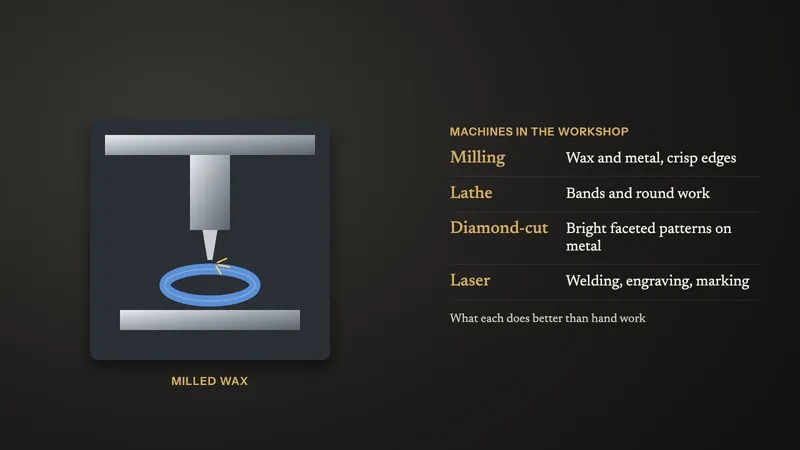
CNC stands for computer numerical control: a machine whose movements are driven by a program instead of a hand on a handle. The design is drawn in CAD, a second program (CAM) works out the path the cutting tool must follow, and the machine follows that path, usually written as a list of coordinates called G-code. Where a 3D printer adds material layer by layer, most CNC machines remove it, cutting the shape out of a solid block of wax or metal.
CNC milling: wax and metal
A milling machine holds a small rotating cutter and moves it across the material. The number of axes says how many ways it can move:
- Three axes (left-right, forward-back, up-down) cut from one side, like carving a relief.
- Four axes add a rotary axis that turns the work, so a ring blank can be cut all the way round.
- Five axes also tilt the tool or the work, reaching undercuts and complex forms in one setting, at a higher price and with more care needed to keep the machine aligned.
Three- and four-axis machines are the most common in jewellery. Most mill carving wax to make casting patterns; heavier machines mill metal directly, for pieces such as signet rings, bands and engraved plates.
Milling or printing?
Milled wax and printed patterns compete for the same job, and each has its strengths:
| Milled wax | 3D-printed pattern | |
|---|---|---|
| Best at | Crisp lettering, flat faces, straight edges, bangles, buckles | Organic shapes, undercuts, hollow forms, fine filigree |
| Pieces per run | Usually one at a time (flat pieces can be grouped) | Many pieces on one build platform |
| Limits | Tool shape: tapered cutters, tiny flat at the tool tip, no deep undercuts on fewer than five axes; thin models vibrate | Layer lines, support marks, resin burnout needs care |
| Casting | Burns out like any carving wax | Depends on the material: see our 3D printing guide |
| Running cost | Low: wax is cheap and offcuts can be reused | Resin and printer upkeep; wax printers cost more to buy |
Many workshops use both: a mill for signets, lettering and flat work, a printer for everything with curves and undercuts. See our guide to 3D printing for jewellery for the printing side.
CNC lathes: bands and round work
A lathe spins the work while a fixed tool cuts it. CNC lathes turn wedding bands from tube or rod with a consistent profile (flat, court or comfort fit), and cut grooves and patterns at the same setting. Swiss-type lathes, built for small precise parts, make findings, screws and fittings in large numbers. Bands made this way from worked metal avoid casting porosity altogether, which is why some makers use seamless tube or extrusion for their bands.
Diamond-cut machines
The sparkling faceted finish on many gold chains, bangles and beads is cut by machine with a diamond-tipped tool that shaves small, angled, mirror-bright facets into the metal. Hand engravers once did the same with a graver (bright-cutting); the machine version repeats the facets with perfect regularity, on whole lengths of chain or on a rotating bangle. It is a finishing step: the piece is made first, then cut, and a light touch is needed when repairing or polishing it later, because heavy polishing rounds the facets off.
Lasers in the workshop
Lasers do three different jobs in jewellery:
- Welding. A pulsed laser melts a spot a fraction of a millimetre wide in a few milliseconds, so heat stays local. That allows repairs next to many stones, joins without solder (so multi-coloured gold keeps its colours), and filling of casting porosity with wire of the same alloy. High-speed chain machines spot-weld gold links by laser, and benchtop laser welders are now common in repair workshops. Some stones and treated or filled stones still do not tolerate the heat: check before welding near them.
- Marking and engraving. A scanning laser engraves carat marks, maker's marks, serial numbers, logos and personal messages, including inside rings, with spots of a few hundredths of a millimetre.
- Cutting. Lasers cut precise shapes from sheet metal, such as pierced pendants and letters, in small batches without a stamping die.
What is new
The direction of recent years is more steps in one machine and fewer by hand: five-axis milling that finishes a piece in one setting, lasers that weld, cut and mark on the same bench, and printers that print metal directly (see our 3D printing guide). Precious metals are hard for lasers, because they reflect much of the light; green and blue lasers, which gold absorbs better, are one of the answers being developed. What does not change: every machine still needs a skilled hand for setting, finishing and quality control.
Where to see the machines
The best way to compare machines is to see them run on the same piece. Trade fairs in our fairs and events calendar have dedicated areas: T.GOLD, the machinery and technology show held with Vicenzaoro in January, and the MJSA Showcase of tools and equipment at JA New York Spring.
Facts last checked: 24 October 2026.
Share this article
Sources
- Shawna Kulpa: CNC milling vs. 3D printing (Ganoksin, from MJSA Journal, 2017)
- Shele Letwin: Mill or 3D printer? (Jewellery Business, 2013)
- Joshua M. Gold: Lasers make bling, laser welding and marking in jewellery manufacturing (Laser Focus World, 2006)
- University of Cambridge, Phase Transformations group: laser welding of jewellery (with Rofin-Baasel)
- Thangamani and others: A comprehensive review of laser powder bed fusion in jewelry, including green and blue lasers (Metals 14, 897, 2024)
- Gold Bulletin (Springer): report on the 25th Santa Fe Symposium (2011), including P. Nordt on making seamless wedding bands
- Vicenzaoro: T.GOLD, machinery and technology for the goldsmith industry
- Jewelers of America and MJSA: events, including the MJSA Showcase at JA New York