Spinel: colours, sources, treatments and synthetics
The gem that was mistaken for ruby for centuries: properties, what causes each colour, the main mines, quality factors, heat and diffusion treatments, synthetics, how to separate it from ruby at the bench, and care.
For most of history, nobody knew spinel existed. The great red stones of Asian and European treasuries were called rubies, or "balas rubies", and some of the most famous still carry that name: the Black Prince's Ruby in the British Imperial State Crown is a large red spinel, worn by English kings since the fourteenth century. Only in 1783 did the French mineralogist Romé de l'Isle show that spinel is a separate mineral from ruby.
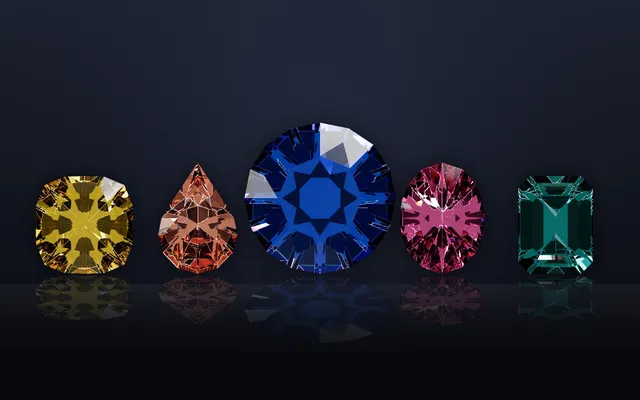
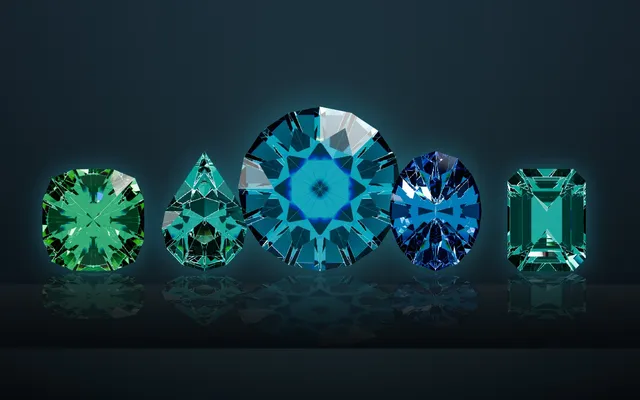
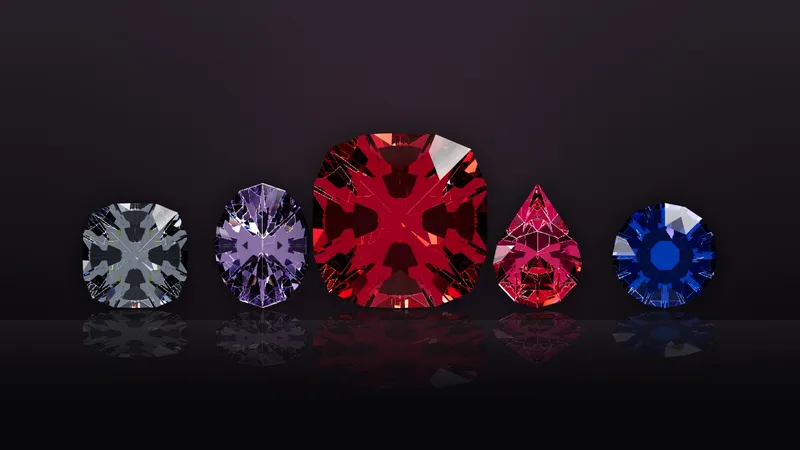
Today spinel is valued on its own terms: hard, bright, usually untreated, and found in reds, pinks, purples, blues and greys that no other gem quite matches. It joined the August birthstone list in 2016. This guide covers what a professional needs: the properties, what causes each colour, where it is mined, how it is graded, the treatments and synthetics on the market, and how to look after it at the bench.
Key properties
| Property | Typical value |
|---|---|
| Mineral | Spinel, magnesium aluminium oxide (MgAl₂O₄) |
| Crystal system | Cubic; rough often forms sharp octahedra, sometimes twinned ("spinel-law" twins) |
| Hardness (Mohs) | 8 |
| Toughness | Good; no cleavage |
| Refractive index | About 1.718 (natural); singly refractive |
| Specific gravity | About 3.60 (3.54 to 3.63) |
| Pleochroism | None |
| Fluorescence | Red and pink stones often glow red under long-wave UV |
| Usual treatment | Usually none; occasionally heat |
These figures match our gemstone reference table.
What causes each colour
Pure spinel is colourless. Its colours come from small amounts of other elements taking the place of magnesium or aluminium in the crystal:
- Red and pink: chromium, the same element that colours ruby. Chromium also causes the strong red fluorescence that makes the best stones glow in daylight.
- Blue, violet and grey: mostly iron. Iron-coloured blues tend towards greyish or violetish blue.
- Vivid "cobalt" blue: cobalt, often only a few tens of parts per million, gives a pure, saturated blue that is among the rarest spinel colours. Most stones contain iron as well, which pulls the colour towards grey.
- Purple, lavender, orange and mixed shades: combinations of chromium, iron and other trace elements.
Where spinel is mined
| Source | Known for |
|---|---|
| Mogok and Namya, Myanmar | Classic red and pink from marble; Mogok's intense neon pink-red "Jedi" stones |
| Mahenge, Tanzania | Found in the late 1980s; neon pink to red, sometimes very large crystals (an exceptional find in 2007); newer cobalt-bearing blues |
| Luc Yen, Vietnam | Red, pink and purple since 1988; famous for cobalt blue, usually small (often under 1 ct) and pastel |
| Sri Lanka | Pink, purple, blue and grey from gem gravels |
| Kuh-i-Lal, Tajikistan (historic Badakhshan) | Source of the historic "balas rubies" |
| Pakistan, Afghanistan, Madagascar | Pink and red, variable supply |
| Malawi | Newer production of red to pink rough (GIA report, 2025) |
Origin reports are available from the major laboratories. As with ruby, Burmese origin usually carries a premium, and the lab's opinion rests on inclusions and trace-element chemistry, not on colour alone.
Quality factors
- Colour comes first. The most sought-after are a pure, saturated red; vivid neon pink to red with little grey or brown (the trade's "Jedi" stones); and saturated cobalt blue. Grey and brown modifiers lower the value, but steely grey and lavender spinels have their own following among designers.
- Clarity. Spinel is often cleaner than ruby, so buyers expect eye-clean stones in most colours. Typical natural inclusions are tiny octahedral crystals, often in rows or planes, and "fingerprints" of healed fractures.
- Size. Fine red and pink spinel is rare above about 5 ct, and fine cobalt blue is rare above about 1 ct. Larger stones exist, but price per carat rises steeply with size.
- Cut. Much spinel is cut in source countries to keep weight, with deep pavilions or uneven outlines. A well-cut stone shows good brilliance for a singly refractive gem, helped by spinel's usually clean crystal. Allow for recutting when you buy native-cut rough-shaped goods for calibrated work.
Treatments
Spinel's reputation as an untreated gem is mostly deserved, but it is no longer safe to assume. Three treatments are documented by GIA:
- Heat treatment. Some spinel is heated to improve colour or clarity. It is much less common than in ruby and very hard to see: microscope features are often missing. The standard test is photoluminescence: in unheated stones the main chromium emission line is sharp, and after heating it becomes broader and shifts slightly. GIA reported this broadening after heating at only 800 to 900 °C (2021). In a 2026 case, a 3.37 ct red stone submitted as ruby turned out to be heated spinel with glass-filled fractures: its chromium line sat near 687.5 nm with a width of about 4.1 nm, against about 685.5 nm and 0.9 nm for unheated spinel.
- Fracture filling. Glass or other fillers in surface-reaching fractures, as in the case above. Filled stones need gentle handling.
- Diffusion. In 2023 GIA studied blue to bluish-green spinel sold as "cobalt diffused". The colour actually came from nickel, diffused from the surface: nickel reached 10,000 to 20,000 ppma at the rim, with lithium up to about 3,000 ppma, and the colour was concentrated in a thin layer. Diffusion-treated spinel can only be confirmed by a laboratory.
Any treatment must be disclosed to the buyer. See our guide to gemstone treatments and disclosure.
Synthetic spinel and imitations
Synthetic spinel has been made since the early twentieth century and is cheap and common:
- Flame-fusion (Verneuil) synthetic spinel usually contains extra aluminium, which raises its refractive index to about 1.728 and its specific gravity to about 3.64, both above natural spinel. Except in red, it usually shows strong strain patterns under the polariscope ("tabby" anomalous double refraction), and it may contain gas bubbles. It has long been used to imitate other gems: aquamarine, blue zircon, blue sapphire, and colourless stones as a diamond imitation.
- Flux-grown synthetic spinel (red, pink and blue) has the same refractive index and specific gravity as natural spinel, so bench tests cannot separate it. Flux inclusions and platinum platelets are clues; certainty needs a laboratory.
Glass and doublets also imitate spinel. For any important red, pink or cobalt-blue stone, a report from a recognised laboratory is the norm. See how to read a gem lab report.
Spinel or ruby? Bench checks
Red spinel and ruby still turn up in the same parcels. These classic tests separate them before you send anything to a lab:
| Test | Spinel | Ruby (corundum) |
|---|---|---|
| Polariscope | Singly refractive (may show strain) | Doubly refractive |
| Dichroscope | No pleochroism | Purplish red and orangy red |
| Refractive index | About 1.718, single reading | 1.762 to 1.770, two readings |
| Specific gravity | About 3.60 | About 4.00 |
| Hand spectroscope | Several fine bright lines in the red ("organ-pipe" pattern) | Bright doublet near 694 nm |
These tests tell you which mineral you have. They do not tell you whether a spinel is natural, synthetic or treated; for that, use a laboratory.
Setting, repairs and care
- Wear. At 8 on the Mohs scale with no cleavage, spinel suits rings and everyday jewellery.
- Heat. High heat can fade some colours. Remove the stone, or shield it well, before heavy torch work such as retipping or sizing close to the setting.
- Cleaning. Warm soapy water and a soft brush are always safe. Ultrasonic and steam cleaners are usually safe for untreated stones without fractures, but avoid them for fracture-filled or diffusion-treated stones.
- Light and chemicals. Spinel is stable to light and common chemicals.
Buyer's checklist
- Ask the seller in writing whether the stone is natural and whether it is treated; put the answer on the invoice.
- For important red, pink and cobalt-blue stones, ask for a recent report from a recognised laboratory, including heat and origin where relevant.
- Be wary of "cobalt-diffused" or unusually cheap blue spinel: check for diffusion.
- Check red parcels for ruby, and ruby parcels for spinel.
- Judge colour in daylight-equivalent light, and check for grey or brown under warm indoor light.
Try it yourself
- Hue, tone and saturation →How the trade describes a coloured stone's colour: hue, tone and saturation
- Hardness and toughness →Scratch resistance and breakage resistance compared, gem by gem
- Birthstones around the world →Every month on the American, British, Japanese and nine-gem lists
- Where gems come from →A world map of where each gem is mined, today and historically
Share this article
Sources
- GIA: spinel gem overview
- GIA: spinel description
- GIA: spinel care and cleaning
- GIA Gems & Gemology, Summer 2026 lab notes: heat-treated spinel
- GIA Gems & Gemology, Fall 2021: spectroscopic features of low-temperature heated spinel
- GIA Gems & Gemology, Summer 2023: nickel diffusion in spinel
- Pardieu, Hunting for "Jedi" spinels in Mogok, Gems & Gemology, Spring 2014
- GIA Gems & Gemology, Spring 2021: visual guide to micro-features of spinel
- Shigley and Stockton, 'Cobalt-blue' gem spinels, Gems & Gemology, Spring 1984
- Italian Gemological Review glossary: synthetic spinel
- Italian Gemological Review: cobalt-blue spinels are coming back, but they are not from Vietnam (2023)
- International Colored Gemstone Association: spinel
- International Gem Society: synthetic spinel