Gem lab reports: what each section means
What each section of a diamond grading report and a coloured stone report means, what a report does not tell you, and how to check it matches the stone.
By JewelLoop Editorial Team
5 October 2026
Reviewed 11 October 2026
2 min read
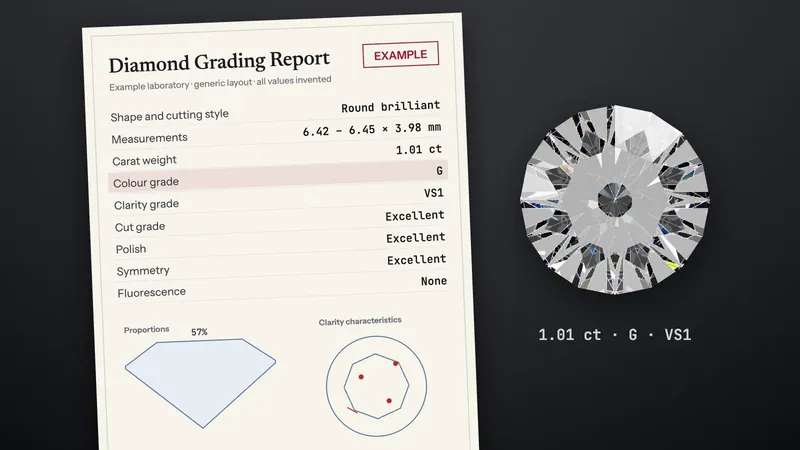
A laboratory report describes one stone as the lab found it on the day it was tested. Read properly, it protects both buyer and seller. Read carelessly, it can be matched to the wrong stone or taken for something it isn't. Here is what to look for.
Diamond grading reports
- Report number and date: used to verify the report online.
- Shape, cutting style and measurements: the first thing to check against the stone.
- Carat weight: to two decimals (some labs give more).
- Colour and clarity grades, and a cut grade for standard round brilliants at many labs.
- Polish, symmetry and fluorescence.
- Proportions diagram and clarity plot: a map of the main inclusions, very useful for identifying the stone.
- Inscription: many diamonds carry the report number laser-inscribed on the girdle, visible with a loupe.
- Origin of the diamond: lab-grown diamonds are clearly identified as laboratory-grown.
Coloured stone reports
- Identification: the species and variety, e.g. corundum, variety ruby. Synthetic stones are named as such.
- Treatment: wording such as "no indications of heating" or "indications of heating", and for emeralds the amount of clarity enhancement (e.g. minor, moderate, significant).
- Origin: some labs give a geographic origin. This is an expert opinion based on scientific data, and labs can disagree.
- Weight, measurements and colour description.
Our guide to treatments and disclosure explains the treatment terms.
What a report does not tell you
- Value. A grading report is not an appraisal or a valuation.
- Anything after the test date. Stones can be damaged, re-cut or treated later.
- That the report belongs to this stone, unless you check.
Find laboratories worldwide in our gem laboratories directory.
Try it yourself
- Gem property lookup →Refractometer, balance and polariscope readings against 47 gems and look-alikes
- Six-prong solitaire, taken apart →A solitaire ring in 3D: its parts, and how proportions change the cut grade
- Diamond colour, D to Z →One diamond moved along the D-to-Z colour scale, face-up and in the grading tray
- Diamond clarity map →Every clarity characteristic GIA defines, inside a diamond you can turn
- Diamond fluorescence →None to Very Strong under the lamp, and what research found about daylight
- How to read a lab report →Each part of a laboratory report explained, on an example report
Share this article
Sources
- International Gem Society: How to read a GIA diamond grading report
- GIA: Colored stone services and reports
- LMHC Information Sheets (report wording)
Facts last checked on 11 October 2026.