Sapphire: properties, treatments and buying checks
Properties, colour, quality, treatments, synthetics, origin reports, weight estimation, setting and care of sapphire: the facts that matter when you buy, set and sell it.
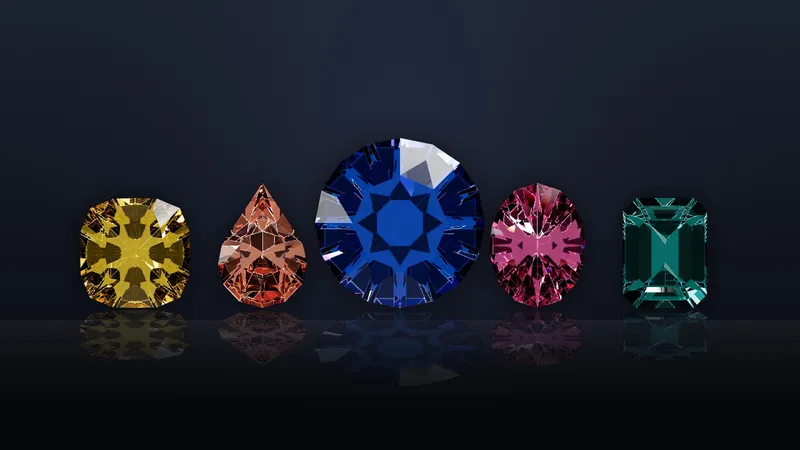
Sapphire is the mineral corundum, aluminium oxide (Al2O3). Red corundum is ruby; every other colour is sapphire. On laboratory reports, "sapphire" alone means the blue variety, and other colours carry their colour name, for example yellow sapphire or pink sapphire.
| Property | Value |
|---|---|
| Species | Corundum (Al₂O₃) |
| Mohs hardness | 9 |
| Toughness | Excellent; no cleavage, but parting along twin planes is common |
| Refractive index | 1.762 to 1.770 |
| Birefringence | 0.008 to 0.010 |
| Specific gravity | 4.00 (typical) |
| Colours | Every colour except red (red corundum is ruby) |
| Phenomena | Star (asterism) from oriented rutile needles; colour change |
Colour
Pure corundum is colourless. Blue comes from small amounts of iron and titanium: only a few hundredths of a percent are enough, and more iron gives a darker blue. Chromium causes the pink of pink sapphire (and the red of ruby). Fancy sapphires come in violet, green, yellow, orange, pink, purple and intermediate hues.
Colour has the greatest influence on value. GIA describes the most valued blue sapphires as velvety blue to violetish blue in medium to medium-dark tones, with strong to vivid saturation; the more intense and even the colour, the more valuable the stone.
Clarity and cut
Blue sapphires usually contain some inclusions, though generally fewer than rubies. Fine intersecting rutile needles are called silk; they can soften the look of a stone, and in many fine Kashmir sapphires tiny inclusions create the prized velvety appearance. Cutters orient the rough for colour zoning and pleochroism (sapphire shows slightly different colours in different directions) while saving as much weight as possible, so proportions vary widely. Most commercial blue sapphires weigh under 5 carats, and size has a strong effect on the price of fine stones.
Treatments
Heating is very common in sapphire and is a stable treatment. Other treatments need more care, and every treatment must be disclosed:
- Heating to modify colour or transparency. See our guide to heat treatment of ruby and sapphire.
- Lattice diffusion of an element from outside the stone (for example beryllium or titanium) during heating. The created colour can be shallow, and re-cutting or surface damage can remove it.
- Glass filling of fractures, much rarer in sapphire than in ruby. Lead glass can be damaged by chemicals as mild as lemon juice.
Laboratories describe these with standard wording; the treatment codes and care notes are in our gemstone reference table.
Synthetics and imitations
Synthetic corundum has been made for more than a century and is chemically the same as natural sapphire, so it must be disclosed as laboratory-grown or synthetic. Assembled stones (doublets) and glass imitations also exist. For important stones, rely on a laboratory, not on appearance.
Origin
Sapphires come from many sources, including Sri Lanka, Madagascar, Tanzania, Myanmar, Australia, Kashmir and Montana. A geographic origin on a report is an expert opinion based on inclusions, trace-element chemistry and spectroscopy. When deposits are geologically similar their stones can be almost identical, and laboratories may give no origin or call it inconclusive. Origin can never be judged from appearance alone.
Estimating weight from measurements
With a specific gravity of 4.00, sapphire is denser than diamond, so a sapphire of the same size weighs more. A well-proportioned oval of 7 × 5 × 3.5 mm comes out at about 1.0 ct: 0.98 ct with the factor 0.0020 used in many course books, 1.03 ct with 0.0021, which our estimator uses. Cutting proportions can move the real weight noticeably either way. Try your own measurements in the gem carat weight estimator.
Setting, cleaning and care
Hardness 9, excellent toughness and no cleavage make sapphire one of the best stones for rings and everyday wear. Many stones do show parting: flat breaks along twin planes, sometimes seen as straight lines or sheens under the loupe. Check for it before setting and avoid strong pressure across those planes. Untreated, heated and lattice-diffused stones are stable to heat, light and common chemicals, and ultrasonic and steam cleaning are usually safe. Two exceptions matter at the bench:
- Boric acid powder (used with some fluxes) etches the surface even of untreated sapphire.
- Fracture-filled, cavity-filled or dyed stones should only be cleaned with a damp cloth and protected from heat and chemicals.
Share this article
Sources
- GIA: Sapphire (gem encyclopedia, description and quality factors)
- GIA: Sapphire care and cleaning guide
- LMHC Information Sheets #1–#4 and #7 (corundum report wording, padparadscha)
- Groat et al., A review of analytical methods used in geographic origin determination of gemstones, Gems & Gemology, Winter 2019