Heat treatment of ruby and sapphire: how labs detect and report it
Why corundum is heated, what heating changes inside a stone, how laboratories detect and word it, and how heating differs from diffusion and glass filling.
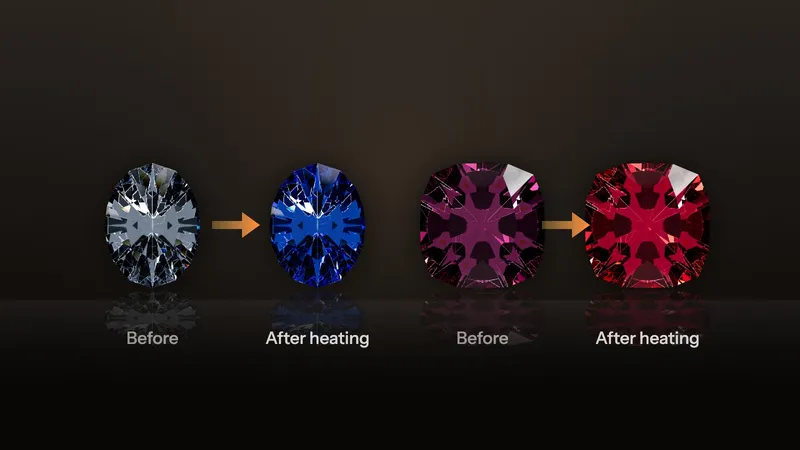
Heating is the most common treatment of ruby and sapphire. It is done to modify colour or transparency, and the result is generally stable: GIA describes heated corundum as very durable. Heating is still a treatment, and buyers, laboratories and trade codes treat it as information that belongs on the invoice.
Temperatures and what changes
| Heating | Approximate temperature | Typical evidence |
|---|---|---|
| Low-temperature heating | about 700 °C up to roughly 1,200 °C | Very small or no visible changes; some inclusions (e.g. carbonates, negative crystals) may alter; often detectable only by spectroscopy, and not always |
| Conventional (high-temperature) heating | above about 1,200 °C, up to about 1,800 °C | Rutile silk partly or fully dissolves; disc-shaped tension cracks around inclusions; fissures may heal, leaving residues |
Temperatures are as reported by SSEF and GIA research; exact behaviour depends on the stone and the heating conditions.
How laboratories detect it
Gemmologists look for heat-altered inclusions under the microscope and use infrared (FTIR) and Raman spectroscopy, which can show changes invisible to the eye. Low-temperature heating is the hardest to prove: rutile is only affected from about 1,200 °C, and the spectroscopic signs are not always present. Even the best laboratories cannot always detect heating.
How reports word it
The members of the Laboratory Manual Harmonisation Committee (LMHC): CGL, CISGEM, DSEF, GIA, GIT, Gübelin and SSEF, use standard wording:
- No indications of heating (NH): the lab found no evidence. This is not proof that a stone was never heated.
- Indications of heating (H): evidence of heating to modify colour or transparency. "Indications of (low temperature) heating" may be used when only some features have changed.
- Residues in healed fissures or cavities: heating can heal fractures, sometimes with flux-related residue. Labs grade the amount, from minor to significant.
Not the same as heating
| Treatment | What it is | What to know |
|---|---|---|
| Lattice diffusion | Heating with an element added from outside, such as beryllium or titanium | Reported as diffusion or "introduction of a chemical element from an external source". Beryllium cannot be detected with standard gemmological instruments; labs use LA-ICP-MS or SIMS. Colour may be shallow. |
| Glass filling | Fractures and cavities filled with glass, often lead glass | Reported with an extent (minor to significant). The glass is unstable to heat and chemicals; unmount before repairs. |
| Corundum with glass | Heavily fractured material or many small pieces held together by glass | Reported as a manufactured product; if the glass is damaged the stone may fall apart. |
Trade terms such as "surface diffusion" or "heated with beryllium" are common in the market but are not used by LMHC laboratories, which use the standard descriptions above.
Disclosure in practice
- Write the treatment on the invoice and memo: "heated", or the AGTA code H.
- For valuable stones, back the description with a laboratory report, and keep it with the stone.
- Say "no indications of heating" only when a report says so; never "guaranteed unheated".
- Pass the information on to whoever sets, sells or repairs the stone.
More on treatments and disclosure: common gemstone treatments and our sapphire guide.
Share this article
Sources
- LMHC Information Sheet #7: Corundum, no indications of heating / indications of heating (2023)
- LMHC Information Sheets #1, #2, #3 (residues, lattice diffusion, glass filling; 2025)
- SSEF: Low-temperature heating of corundum, possibilities and challenges for detection (Facette 29, 2024)
- Hughes & Vertriest, A Canary in the Ruby Mine: low-temperature heat treatment experiments on Burmese ruby, Gems & Gemology, Winter 2022
- GIA: Beryllium in corundum (GIA Insider, January 2007)
- GIA: Ruby and sapphire care and cleaning guides