Lab-grown diamonds: what you must call them, country by country (2026)
The words you may and may not use for laboratory-grown diamonds in the US, UK, EU, France, Belgium, India, Russia and China, with the 2025 and 2026 changes: India's new standard, Russia's "synthetic" rule, GIA's new reports and CIBJO's vote.
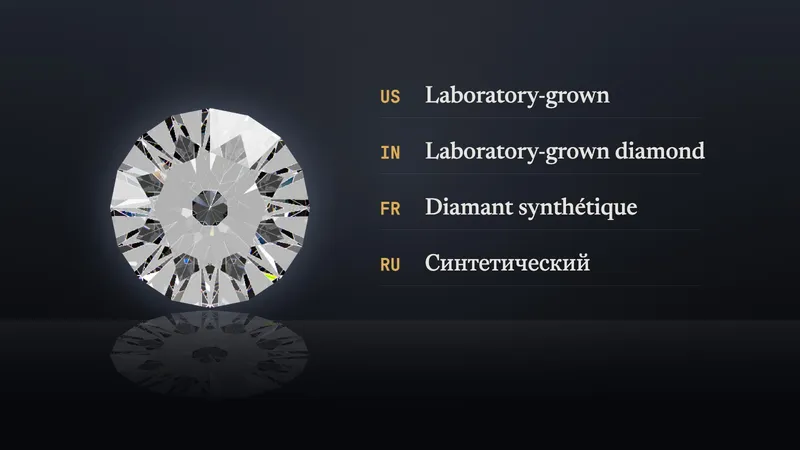
A laboratory-grown diamond is real diamond: the same carbon, the same crystal structure, the same hardness. What is different is its origin, and the trade, regulators and courts agree that buyers must be told about it, clearly and every time. What they do not agree on is which words to use. A label that is required in New York can be banned in Mumbai, and since 1 September 2026 Russia uses a different word again.
2025 and 2026 brought more change than the previous ten years: India adopted a national standard, the UK advertising regulator ruled against retailers, GIA changed how it reports lab-grown stones, Russia rewrote its labelling rules, and CIBJO, the world jewellery confederation, voted to make "synthetic" its only term. This guide sets out the rules as they stand in October 2026, market by market, and what they mean for your invoices, labels and advertising.
The common starting point: ISO 18323
Most national rules build on the international standard ISO 18323:2015 (Jewellery: consumer confidence in the diamond industry) and on CIBJO's Diamond Book. Their core ideas are the same almost everywhere:
- The word "diamond" on its own means a natural diamond.
- A laboratory-grown diamond must always carry a qualifier, placed with the word "diamond", in the same size and prominence, wherever the stone is described: label, invoice, website, advert, social post.
- Misleading words are out: "real", "genuine", "natural", "precious", "cultured" or "cultivated" for a lab-grown stone.
- The disclosure has to travel down the chain, from grower to cutter, wholesaler, manufacturer and retailer.
Where markets differ is the qualifier itself: "laboratory-grown", "laboratory-created", "synthetic", or a manufacturer's name.
At a glance
| Market | Accepted terms | Not allowed | Rule |
|---|---|---|---|
| United States | Laboratory-grown, laboratory-created, [manufacturer]-created; "synthetic" is allowed but not required | Unqualified "diamond"; "cultured" without a clear statement that the stone is not mined | FTC Jewelry Guides, 16 CFR 23.12 (2018) |
| European Union | No single EU term; national rules apply | Anything misleading about origin | Unfair Commercial Practices Directive |
| France | Diamant synthétique (diamant de synthèse) | Cultivé, de culture, de laboratoire | Decree 2002-65 |
| Belgium | Synthetic; documents must state natural or synthetic | Unqualified "diamond" for a synthetic | Royal Decree 2023, from 1 May 2023 |
| United Kingdom | Laboratory-grown, laboratory-created, synthetic | Unqualified "diamond" in ads, including in a brand name | CAP Code, ASA rulings May 2026 |
| India | Laboratory-grown diamond, laboratory-created diamond (in full) | LGD, lab-grown, lab diamond, synthetic, cultured, eco-friendly, pure, earth-friendly | BIS IS 19469:2025, from 27 January 2026 |
| Russia | Synthetic (in Russian), abbreviation allowed | "Brilliant" (бриллиант) and diamond grading terms for synthetics; precious, real, genuine, natural, mineral, eco-friendly; weight in carats | Government resolution of May 2026, from 1 September 2026 |
| China | Synthetic (合成) in the national naming standard; "cultivated" (培育) is common in trade | Unqualified diamond (钻石) for a synthetic | GB/T 16552-2017; group standards |
United States: FTC Jewelry Guides
The US Federal Trade Commission's Jewelry Guides (16 CFR Part 23) were revised in 2018. Under section 23.12, a laboratory-made stone must be described with a word that clearly discloses its nature: "laboratory-grown", "laboratory-created", "[manufacturer name]-created" or another word of the same meaning. "Synthetic" remains allowed but is no longer required. The 2018 revision also removed the word "natural" from the FTC's definition of a diamond, which is why US marketing uses "lab-grown diamond" so freely.
Two limits matter in practice. "Cultured" may be used only together with a clear and conspicuous statement that the stone is not mined, and the qualifier must sit with the word "diamond" with equal prominence, not in small print. In 2019 the FTC sent warning letters to eight companies over lab-grown advertising, and the guides are next due for review in 2028.
European Union, France and Belgium
There is no single EU term. Across the EU, the Unfair Commercial Practices Directive forbids any presentation that misleads consumers about the nature or origin of a product, and each country can set its own naming rules.
France has the strictest wording. Decree 2002-65 on the trade in gemstones requires the adjective "synthétique" for stones made by humans that reproduce natural ones, and bans "cultivé" and "de culture". "Diamant de laboratoire" is not one of the permitted terms, and the French consumer authority (DGCCRF) has reported brands using misleading terms. French members of parliament have asked the government to allow "créé en laboratoire"; at the time of writing the decree has not been changed.
Belgium, home of the Antwerp trade, adopted a Royal Decree in 2023: from 1 May 2023, any document accompanying a diamond sale must state its weight and whether the stone is natural or synthetic. The Antwerp World Diamond Centre also warns consumers about wording that blurs the difference. The Belgian economy minister has said the government is examining whether to reserve the word "diamond" for natural stones only; as of October 2026 that is a proposal, not law.
United Kingdom: the advertising regulator acts
The UK has no diamond naming law, but advertising must follow the CAP Code, enforced by the Advertising Standards Authority (ASA). The National Association of Jewellers' terminology guideline follows ISO 18323 and CIBJO.
In May 2026 the ASA upheld complaints from the Natural Diamond Council and the London Diamond Bourse against two retailers, Novita Diamonds and Linjer. The ASA accepted that lab-grown and natural diamonds share the same chemistry, but ruled that origin is material information: it must be in the advert itself, not only on the website. One point surprised many: when a brand name contains the word "diamonds", the advert needs a qualifier even if the copy never says "diamond". An earlier ruling against another retailer made the same point about "real diamond" claims.
India: a national standard from January 2026
India, the world's largest diamond cutting centre and a major lab-grown producer, now has the most detailed rules. The Bureau of Indian Standards (BIS) published IS 19469:2025, a modified adoption of ISO 18323, which took effect on 27 January 2026. As reported by the Antwerp diamond institute AIDI and Indian trade press:
- "Diamond" without a qualifier means a natural diamond only.
- Laboratory-grown stones must be called "laboratory-grown diamond" or "laboratory-created diamond", written in full.
- Abbreviations are not allowed: no "LGD", "lab-grown" or "lab diamond" on their own.
- Also banned for lab-grown stones: "synthetic" (in India's version), "cultured", "eco-friendly", "pure", "nature's", "earth-friendly" and similar claims.
- The growth method (CVD or HPHT) and any after-growth treatment must be disclosed.
Note the twist: India bans "synthetic", while France and Russia require it. If you sell into both, you need different labels.
Russia: "synthetic" from 1 September 2026
Russia's government approved new rules at the end of May 2026 (reported as Government Resolution No. 657), in force from 1 September 2026. As reported by trade press:
- Laboratory-made stones must be labelled synthetic; the resulting description is "synthetic cut diamond" rather than "brilliant".
- The Russian word for a cut diamond, бриллиант, is reserved for natural stones. Jewellery may use "diamond" only if it contains natural stones.
- The 4Cs grading system and colour and clarity terms associated with natural diamonds may not be used for synthetics.
- Weight must be given in grams, not carats.
- Words such as precious, real, genuine, natural, mineral and eco-friendly are banned for synthetic stones.
- The rules reportedly cover the other stones on Russia's precious stones list as well, such as synthetic ruby, sapphire, emerald and alexandrite.
For exporters this is the biggest practical change of the year: a lab-grown parcel invoiced in carats with D to Z grades needs different paperwork for Russian buyers.
China and Hong Kong
China's national standard for gem naming, GB/T 16552-2017, uses "synthetic" (合成) for laboratory-made stones, so a lab-grown diamond is a "synthetic diamond" (合成钻石) in the standard. In everyday trade, Chinese producers and retailers widely use "cultivated diamond" (培育钻石), supported by industry group standards; a proposal to add that term to the national standard had not been adopted as far as we could confirm. In both, an unqualified "diamond" (钻石) means a natural stone.
In Hong Kong, the Trade Descriptions Ordinance makes any false or misleading description of goods an offence, and the trade reads it as requiring a clear qualifier for laboratory-grown stones. Check current guidance from Hong Kong Customs and the trade associations before advertising there.
Laboratory reports: GIA's change in October 2025
Since 1 October 2025, GIA no longer grades laboratory-grown diamonds on the D-to-Z colour and Flawless-to-I3 clarity scales. Its lab-grown reports use two broad descriptions, "Premium" and "Standard", and every stone is laser-inscribed "Laboratory-Grown" with its report number. Other laboratories still issue full 4C grades for lab-grown stones, so a parcel may arrive with very different-looking reports. Whatever the report, the qualifier on your invoice must match it.
CIBJO votes for "synthetic" (September 2026)
CIBJO accepted "laboratory-grown" and "laboratory-created" as alternatives to "synthetic" in 2010. At its 2026 congress, its Board approved on 7 September 2026 in Vicenza a recommendation to make "synthetic" the only descriptor in its Blue Books, removing the other two terms. The African Diamond Producers Association backed the same position earlier in the year.
Two cautions. First, CIBJO's Blue Books are trade guidelines, not law: where a national law sets the words, as in the US, India and France, the law comes first. Second, the change will take time to appear in national standards, if it does at all. Expect "laboratory-grown" to remain legal and common in the US and India, and "synthetic" to gain ground in Europe and Russia.
What to do in practice
- Label for the destination, not the origin. Keep a short terminology sheet per market: "laboratory-grown diamond" for India (in full), "synthetic" for France and Russia, either for the US and UK.
- Put the qualifier on every document: memo, invoice, packing list, certificate, price tag and product page. The rules follow the stone down the chain.
- Never let "diamond" stand alone in adverts, social posts, product titles, search ads or brand names for lab-grown goods.
- Drop the risky adjectives: real, genuine, natural, precious, eco-friendly, sustainable, conflict-free, unless you can prove the claim and the market allows it.
- Russia: show weight in grams and avoid D-to-Z and clarity grades for synthetics.
- India: state CVD or HPHT and any post-growth treatment.
- Keep stock apart. Separate storage, parcel papers and stock codes for natural and lab-grown goods prevent costly mix-ups (see our guide to screening melee for lab-grown stones).
- Review once a year. The rules changed in four major markets in twelve months.
Share this article
Sources
- US FTC Jewelry Guides, 16 CFR 23.12 (eCFR)
- National Jeweler: 8 key changes the FTC made to the Jewelry Guides (2018)
- AIDI: India's BIS redefines "diamond" and bans misleading terms for lab-grown gems
- AIDI: India BIS diamond terminology, natural and lab-grown
- JCK: Russia requires lab-growns to be called synthetics (2026)
- Jeweller Magazine: Russia makes big move in diamond terminology debate (June 2026)
- Caliber: lab-grown diamonds face new labelling rules in Russia (2026)
- JCK: CIBJO votes for "synthetic" in Vicenza (September 2026)
- CIBJO Congress 2026: Diamond Commission special report
- GIA: updated laboratory-grown diamond services launch 1 October 2025
- Belgian FPS Economy: diamonds, administrative obligations
- InStore: Antwerp diamond body warns consumers on natural vs synthetic disclosure
- DGCCRF: quality and conformity of jewellery with stones (France)
- Office québécois de la langue française: "diamant synthétique" (citing French decree 2002-65)
- Jewellery Focus: ASA upholds complaints over Linjer laboratory-grown diamond ads (2026)
- Jewellery Monthly: ASA upholds complaints over unqualified use of "diamond" (2026)
- CIBJO: laboratory-grown diamond guidelines (2024)