Cutting styles: brilliant, step, mixed, cabochon and carving
The main cutting styles and what each does for a gem, precision cutting against native cutting, and the world's main cutting centres for diamonds and coloured stones.
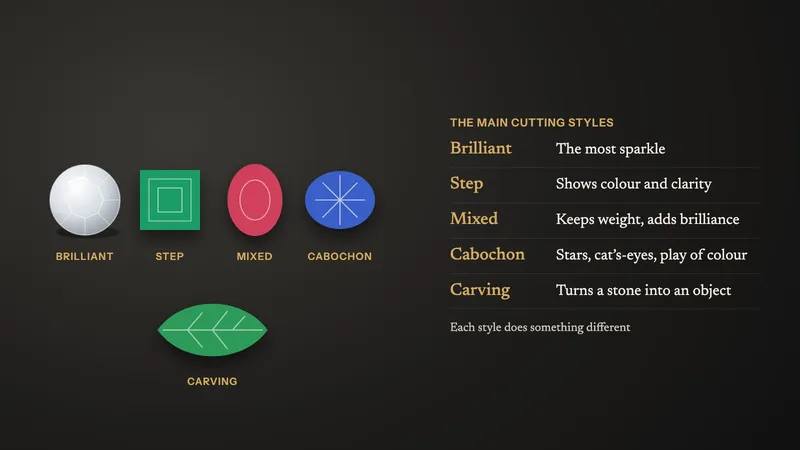
A cutting style is the pattern of facets, not the outline. An oval can be cut as a brilliant or with steps; a cushion can be a brilliant or a mixed cut. The style decides how the stone handles light and colour, and how much of the rough it keeps.
The main styles
| Style | Facets | What it does | Typical gems and shapes |
|---|---|---|---|
| Brilliant | Triangular and kite-shaped facets radiating from the centre | Most sparkle; hides small inclusions and uneven colour well | Round, oval, pear, marquise, heart; most diamonds |
| Step | Long rectangular facets in rows parallel to the girdle | Calm 'hall of mirrors' look; shows colour and clarity openly | Emerald cut, baguette, Asscher; emerald, aquamarine |
| Mixed | Brilliant facets on one part, steps on the other (often a brilliant crown and a step pavilion) | Keeps weight and colour while adding brightness | Many coloured stones, especially ovals and cushions |
| Cabochon | No facets: a smooth dome over a flat or slightly domed base | Shows stars, cat's-eyes, play of colour and translucent colour | Star sapphire, cat's-eye chrysoberyl, opal, jade, turquoise |
| Carving | Shaped surfaces, cameos, intaglios and sculpture | Turns a stone into an object; uses material that would not facet well | Jade, coral, chalcedony, quartz, shell |
Precision cut and native cut
A native or mine cut is cut near the mine mainly to keep weight. Proportions and symmetry fall short of modern standards: deep, bulging pavilions, off-centre culets, windows. GIA's report on Sri Lanka describes such stones as advanced preforms, which is why many are later recut.
A precision cut follows a planned design with exact angles and outlines. Calibrated precision cutting, used for stones that must fit standard settings, works to tolerances of 0.1 mm or less. The price is weight: a precision-cut stone from the same rough is lighter, but brighter and easier to set.
Neither is 'better' for every stone. A well-cut native stone with good colour can be worth more than a precise cut that lost colour to save proportions. The fourth guide in this series looks at that trade-off.
Where gems are cut
| Centre | Known for |
|---|---|
| Surat and Mumbai, India | About 90% of the world's diamonds are polished in India (Antwerp World Diamond Centre), most of them in Surat; press estimates for Surat alone range from 80% to over 90% |
| Antwerp, Belgium | Diamond trading, and polishing of high-end diamonds by a smaller number of cutters than before |
| Jaipur, India | Coloured stones of all kinds, and one of the leading emerald cutting and trading centres |
| Chanthaburi and Bangkok, Thailand | Ruby and sapphire cutting and trading, and heat treatment of corundum |
| Ratnapura and Beruwala, Sri Lanka | Traditional cutting and recutting of sapphire and other Sri Lankan gems; heat treatment around Beruwala |
| Idar-Oberstein, Germany | Precision cutting, carving and Germany's training centre for gem cutters |
See where the rough comes from on our map of gem sources, which also marks the trading and cutting centres.
Facts last checked: 31 October 2026.
Share this article
Sources
- GIA: Gem cutting styles, definitions
- Lucas, Sammoon, Jayarajah, Hsu and Padua: Sri Lanka, expedition to the Island of Jewels (Gems & Gemology, Fall 2014, Vol. 50, No. 3)
- GIA: Jaipur, India, emerald cutting and trading powerhouse (field report)
- GIA: Chanthaburi, sapphire mines, markets and field gemology
- GIA: The rise to prominence of the modern diamond cutting industry in India (Gems & Gemology)
- Gulf News: Surat Diamond Bourse (90% estimate, 2023)
- Antwerp World Diamond Centre: Diamond manufacturing
- Statistisches Landesamt Rheinland-Pfalz: Datenblick 12/2025, Idar-Oberstein, training centre of the jewellery and gemstone trade