Gem cutting: from rough to finished stone
The steps a cutter takes from a piece of rough to a polished gem, the parts of a cut stone, the faceting machine and its laps, and how diamond manufacturing differs.
Most of a gem's beauty is decided before the first facet is cut. The cutter looks at the rough, decides which way the colour runs and where the flaws sit, and chooses a shape that keeps enough weight without giving up brightness. This guide follows a coloured stone from rough to finished gem, then shows how diamond manufacturing differs. It is the first of five guides in our Gem cutting series.
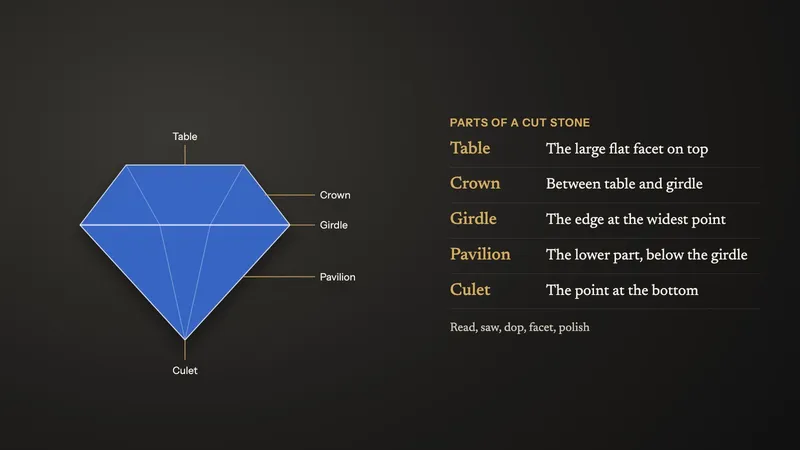
The parts of a cut stone
| Part | What it is |
|---|---|
| Table | The large flat facet on top |
| Crown | The upper part, between the table and the girdle |
| Girdle | The narrow edge at the widest point, where the setting holds the stone |
| Pavilion | The lower part, below the girdle; it sends light back up |
| Culet | The point (or tiny facet) at the bottom of the pavilion |
| Keel | A line instead of a point at the bottom of long shapes such as ovals |
1. Reading the rough
The cutter first decides what the rough can become. Transparent material is usually faceted; translucent and opaque material, and stones with a star or cat's-eye, are cut as cabochons. Then come three questions: where the inclusions and fractures are, how the colour is distributed (many gems show stronger colour in one direction, or in bands), and which outline keeps the most weight.
Orienting the rough so the best colour shows through the table is the step that most affects value. In their report on Sri Lanka, GIA's field gemmologists call it the highest skill in coloured stone cutting, especially for valuable rough.
2. Sawing and preforming
Large or flawed pieces are sawn first, to separate clean parts or remove fractures. The cutter then grinds a preform: the rough outline and approximate angles of the finished stone, ground on a coarse wheel. Preforming removes material much faster than the faceting machine, so the slow, precise work starts close to the final shape.
3. Dopping
The preform is glued to a dop, a metal rod that fits the faceting machine, with dopping wax or epoxy. The stone must sit exactly on the dop's centre line: an off-centre stone gives facets that do not meet.
4. Faceting the pavilion, then the crown
A faceting machine holds the dop in a quill on a mast. Three settings place each facet: the angle (how steep the facet is), the height (how deep it is cut) and the index (where it falls around the stone). The index wheel has a fixed number of teeth; a 96-tooth wheel, standard on many machines and used by most published designs, divides a turn into steps of 3.75°.
Most cutters cut the pavilion first. The stone is then moved to a second dop with a transfer jig, which keeps it exactly aligned, and the crown is cut.
5. Polishing
Facets are ground with diamond laps from coarse to fine (for example 600, then 1200 grit) and then polished on a separate polishing lap, one facet at a time. The polish depends on the gem: for quartz, the International Gem Society describes plastic (Lucite) laps with cerium or tin oxide in water, kept very wet so the stone does not overheat and the facet edges stay sharp. Harder gems such as sapphire are usually polished with fine diamond powder.
How diamond is different
Diamond is cut with the same idea but different tools, because only diamond cuts diamond. GIA's account of modern diamond manufacturing describes four basic techniques: sawing (today mostly by laser), bruting (rounding the girdle, traditionally by spinning one diamond against another), blocking (cutting the main facets) and polishing the remaining facets, a stage the trade calls brillianteering. Before any of this, the rough is scanned and planned by software to find the most valuable combination of stones it can yield.
Facts last checked: 31 October 2026.
Share this article
Sources
- GIA: Gem cutting styles, definitions
- Lucas, Sammoon, Jayarajah, Hsu and Padua: Sri Lanka, expedition to the Island of Jewels (Gems & Gemology, Fall 2014, Vol. 50, No. 3)
- International Gem Society: Faceting made easy, part 2, faceting machines and equipment
- A. Caspi: Modern diamond cutting and polishing (Gems & Gemology, Summer 1997)
- International Gem Society: Rough orientation