Diamond origin rules: the Kimberley Process, G7 sanctions and tracing
Two systems decide which diamonds can cross a border: the Kimberley Process for rough, and the G7 rules on Russian diamonds. What each requires, and what a buyer may ask you to prove.
General information checked against official sources on 15 November 2026. Sanctions rules change often: check the current rules with your customs authority or an adviser before you rely on them.
| Kimberley Process (KP) | G7 sanctions on Russian diamonds | |
|---|---|---|
| Question it answers | Did this rough finance a rebel war? | Was this diamond mined in Russia? |
| Who takes part | 60 participants covering 86 countries (the EU counts as one) | The G7 countries and the EU, each with its own law |
| What it covers | Rough diamonds only | Rough and polished; in the EU also lab-grown diamonds and jewellery containing diamonds |
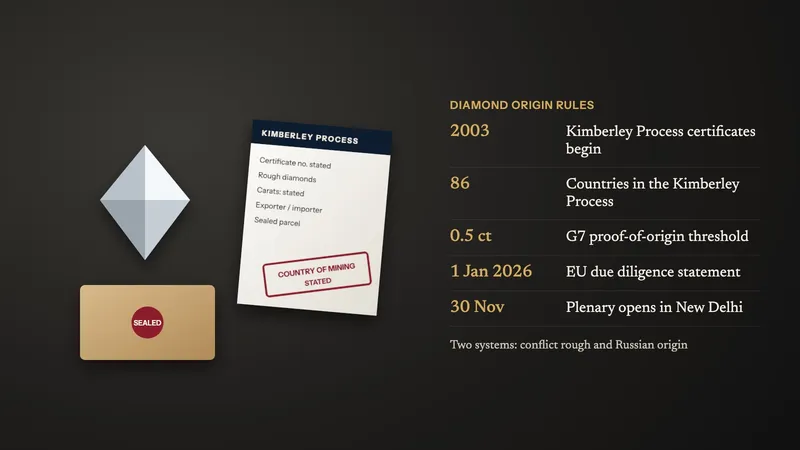
| Paperwork | A KP certificate with every rough shipment between participants | Proof of the country of mining for stones of 0.5 ct and above |
| How rules change | By consensus of all participants | By each government |
The Kimberley Process
The KP certification scheme was agreed in Interlaken in November 2002 and has run since 2003, based on United Nations General Assembly resolution 55/56. It defines conflict diamonds as "rough diamonds used by rebel movements or their allies to finance conflict" against legitimate governments. In practice:
- every export of rough diamonds must travel with a valid KP certificate;
- participants may trade rough only with other participants;
- each participant must have the laws and controls to enforce this, and must report trade and production statistics.
The KP does not cover polished diamonds, jewellery or lab-grown diamonds. A polished stone carries the KP's protection only through the paperwork that followed its rough.
Recent decisions and disagreements
- Central African Republic: the 2024 Plenary in Dubai lifted the embargo on rough exports from the country, in place since 2013.
- Russia: the KP works by consensus, and its participants have not agreed on how to deal with Russian diamonds after the invasion of Ukraine. After the 2024 Plenary the EU said the KP had failed "for a third year in a row" to address it. This is why the G7 built its own system.
- The 2026 chair: the November 2025 Plenary in Dubai could not agree on a chair for 2026. Participants then chose India unanimously by written procedure in December 2025. Ghana is vice chair and is due to chair in 2027.
What is on the table in New Delhi
The Plenary meets at Bharat Mandapam, New Delhi, from 30 November to 4 December 2026. At India's consultation with producing countries in Luanda on 3 November, the topics put forward were:
- the sustainability of diamond-producing countries and communities;
- secure funding for the KP Secretariat;
- digital certificates and digital statistics, in place of paper;
- stronger compliance with the scheme's minimum requirements.
Decisions need the agreement of every participant, so not every proposal will pass. We will update this guide after the Plenary.
The G7 rules on Russian diamonds
On 6 December 2023 the G7 leaders announced phased restrictions on Russian diamonds, including those cut in other countries. Each member wrote its own rules. The main ones:
| Market | Shipped directly from Russia | Cut in another country | What importers must show |
|---|---|---|---|
| European Union | Banned from 1 January 2024 | Banned from 1 March 2024 (1 ct and above); from 1 September 2024 also 0.5 ct and above, lab-grown diamonds, and jewellery and watches containing diamonds | From 1 January 2026, importers of polished natural diamonds of 0.5 ct and above add a Due Diligence Statement on Diamond Origin to every customs declaration; the 20th sanctions package (23 April 2026) reinforced this and extended it to polished diamonds cut in other countries from 24 April 2026 |
| United States | Banned since 11 March 2022 (non-industrial diamonds of Russian origin); diamond jewellery and unsorted diamonds of Russian origin or exported from Russia banned from 1 March 2024 | Banned from 1 March 2024 (1 ct and above) and from 1 September 2024 (0.5 ct and above) | Customs can ask for proof of origin. General licences covered stones already outside Russia before the cut-off dates; check OFAC's current notices |
| United Kingdom | Banned from 1 January 2024, including diamond jewellery | Banned from 1 March 2024 (1 ct and above) and from 1 September 2024 (0.5 ct and above); lab-grown 0.5 ct and above added in 2025. Jewellery made abroad from Russian rough is not covered, but loose stones taken out of it are | Verifiable supply-chain documents (see below) |
Canada and Japan, the other G7 members, signed the same commitment; check their national rules before shipping there.
What counts as proof
The EU's Due Diligence Statement is an "effort obligation": the importer declares the diamonds are not of Russian origin and that they made reasonable efforts to check. The Antwerp World Diamond Centre confirms there is no obligation to use a digital traceability platform; documents are still accepted. The evidence named by the EU and UK authorities includes:
- the original Kimberley Process certificate for the rough;
- the supplier's invoice with a statement of the country of mining;
- a G7 certificate: rough diamonds of 0.5 ct and above can be checked at the Antwerp Diamond Office and given one (optional in the EU);
- for stones cut before the rules began, a "grandfathering" (Gf) number;
- certificates of origin, bills of lading, and laboratory diamond origin reports.
The UK asks that, for any stone of 0.5 ct and above, the papers show the individual stone weight, the country where it was mined, the date it left that country, and where and by whom it was cut.
Tracing: from paper to platforms
Proving origin is easier when it is recorded from the mine onwards. Several producers and laboratories now run digital tracing systems. The largest change this year: in May 2026 the Gemological Institute of America (GIA) took a 30% stake in Tracr, the blockchain platform set up by De Beers, and since April 2026 GIA reports for participating clients can show a Tracr ID and the country of origin. Other laboratories offer their own origin reports. These platforms are a choice, not a legal requirement, in every market listed above.
The trade's own warranty
Separately from the law, the diamond trade uses the World Diamond Council's System of Warranties: a statement on every invoice that the diamonds come from legitimate sources not involved in funding conflict. A revised statement, launched in September 2021, adds commitments on human and labour rights, anti-corruption and anti-money laundering, and requires each company to register with the WDC and complete a self-assessment. After a transition period only the revised statement is in use; check the WDC's website for the current wording.
What this means in practice
- Cutting centres (India and others): keep the KP certificate and the country of mining for every parcel you cut, and keep stones of 0.5 ct and above traceable by weight. Buyers in Europe, the US and the UK will ask.
- Trading hubs outside the G7 (the UAE, Hong Kong, Israel and others): the G7 rules do not apply where you trade, but they apply where your customers import. Pass the origin papers along with the goods.
- Importers in the EU: a Due Diligence Statement with every customs declaration for polished natural diamonds of 0.5 ct and above.
- Mixed parcels: a KP certificate may describe a parcel as of mixed origin. For stones under the G7 rules, the importing country wants the country of mining, so ask your supplier before you buy.
- Lab-grown diamonds: outside the KP, but inside the EU and UK sanctions when they come from Russia. Disclosure rules still apply: see our guide Lab-grown diamonds: what you must call them, country by country.
Related: customs codes for gems and jewellery, checking a gem lab report, and the Kimberley Process in our directory.
General information, not legal advice. Check current sanctions rules with your customs authority.
Share this article
Sources
- Kimberley Process: home page (participants; Plenary 30 November–4 December 2026, New Delhi)
- Kimberley Process: What is the KP?
- National Jeweler: India Chosen as KP Chair for 2026
- KNN India: India holds Kimberley Process consultation in Angola (November 2026)
- IPIS: Kimberley Process lifts conflict diamonds embargo on the Central African Republic (2024)
- EEAS: statement on the 2024 Kimberley Process Plenary in Dubai
- The White House: fact sheet of 22 December 2023 (Executive Orders 14068 and 14114; G7 commitment)
- European Commission: 12th sanctions package (18 December 2023)
- Roschier: EU adopts 20th Russia sanctions package, key changes (April 2026)
- Antwerp World Diamond Centre: sanctions update, 1 January 2026
- Antwerp World Diamond Centre: G7/EU sanctions FAQ
- US Treasury OFAC: FAQ 1165 (thresholds and dates)
- US Treasury OFAC: FAQ 1166 (diamond jewellery and unsorted diamonds)
- UK Government: Guidance on third country processed Russian diamonds measures
- National Jeweler: GIA's Tracr investment (May 2026)
- World Diamond Council: System of Warranties