Checking a gem lab report: online verification and the key checks
How to check that a laboratory report is genuine and belongs to the stone in front of you: each major laboratory's online check, what a match does and does not prove, and a checklist before you buy or sell.
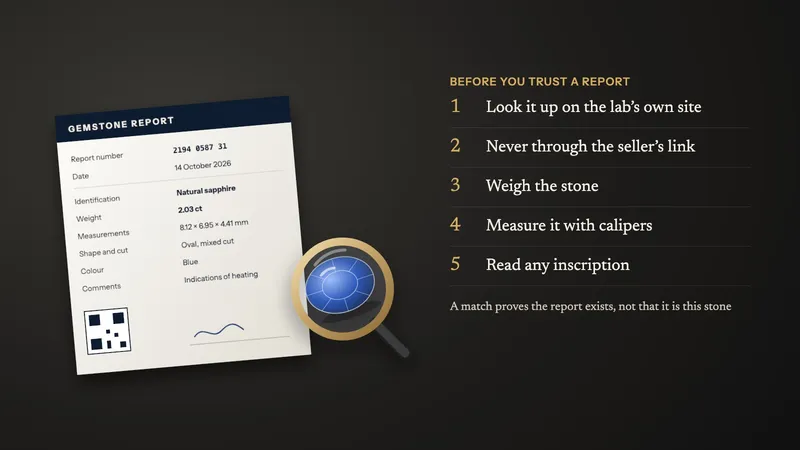
A laboratory report is only worth something if it is genuine and belongs to the stone you are holding. Most major laboratories let anyone look up a report online. That check takes a minute, but it proves less than many people think: it shows that a report with that number exists, not that the paper in your hand or the stone in your tweezers is the one the laboratory examined.
Online checks, laboratory by laboratory
Always type the laboratory's address yourself or use its official app. Do not follow a link, or a QR code, supplied by the seller: a copied website can show a convincing fake record.
| Laboratory | How to check | Worth knowing |
|---|---|---|
| GIA | Report Check on gia.edu: enter the report number; newer reports carry a QR code linking to it | Free. Compares your report with GIA's archived record |
| GRS (GemResearch Swisslab) | Report verification on gemresearch.ch | GRS says a match only shows that such a report may exist; not every report is in the database, and online support is limited to 5 years |
| Gübelin Gem Lab | Report verification form on gubelingemlab.com | The database holds reports issued after 2011 |
| HRD Antwerp | My HRD (my.hrdantwerp.com), the laboratory's report archive | HRD's published price list (2023) says grading results stay in its database for 10 years after issue |
| IGI | Verify Your Report on igi.org: enter the report number | Shows the grading details held for that number |
| Lotus Gemology | Report lookup on lotusgemology.com: report number and PIN, exactly as printed | Reports before February 2015 may have no PIN; new reports can take a couple of days to appear |
| Other laboratories (for example AGL, GIT, SSEF and the Bangkok laboratories in our directory) | Use the laboratory's own website, or contact the laboratory with the report number | Some reports carry a QR code; GIT's Buy With Confidence reports do |
Check the stone against the report
- Weight: weigh the stone on a calibrated scale and compare it with the report; a difference beyond normal scale tolerance is a stop sign.
- Measurements and shape: measure length, width and depth with a millimetre gauge and compare them with the report.
- Inscription: if the report mentions a laser inscription on the girdle, find it with a 10× loupe or microscope and read the number.
- Description: colour, clarity features, the plot or photograph, and fluorescence should all match what you see.
- Natural or lab-grown: check the report's wording. Lab-grown diamond reports say so clearly, and some laboratories use a different report design for them.
- The paper itself: look at the security features the laboratory describes for its reports, and compare every field of the paper with the online record, not just the number.
Common tricks
- A real number on a different stone: the report is genuine, the stone is not the one in it. Weight, measurements and inscription catch this.
- An edited copy: a genuine report scanned and changed, for example to a higher weight or a better grade. Comparing every field with the online record catches this.
- A report from an unknown laboratory: a laboratory's name on paper means nothing on its own. Ask which laboratory, and check that it exists, publishes its methods and can be contacted.
- An old report: stones get recut, damaged or treated after a report is issued, and laboratories' knowledge of treatments and origins improves. GRS recommends having stones with older reports re-checked, especially when they change hands.
A report is an opinion
Laboratories describe their reports as an opinion of the stone at the time it was examined. Grades are not prices, and an origin or treatment statement reflects what the laboratory could determine with its methods at that date. Read our guide How to read a gem lab report and try the interactive report guide for what each field means.
Facts last checked: 31 October 2026. Laboratories change their online services; check the laboratory's own website for the current process.
Share this article
Sources
- GIA: Report Check
- GIA: new report formats with QR codes linking to Report Check (2014)
- GRS GemResearch Swisslab: licence agreement (online report verification)
- GRS GemResearch Swisslab: GRS at GemGenève 2026 (online support limited to 5 years; re-checking older reports)
- Gübelin Gem Lab: Report verification
- HRD Antwerp: My HRD
- HRD Antwerp: price list India (results stored 10 years)
- IGI: Verify your report
- Lotus Gemology: Gem ID report lookup guide
- GIT: Buy With Confidence reports with QR codes
- Gübelin Gem Lab: Gemmological report (a report describes the stone as examined)