700 years of the Goldsmiths' Company: a short history of the hallmark
The Goldsmiths' Company marks 700 years in 2027 with a special leopard's head mark. How hallmarking began in London, and how gold is marked in the main markets today.
By JewelLoop Editorial Team
25 November 2026
2 min read
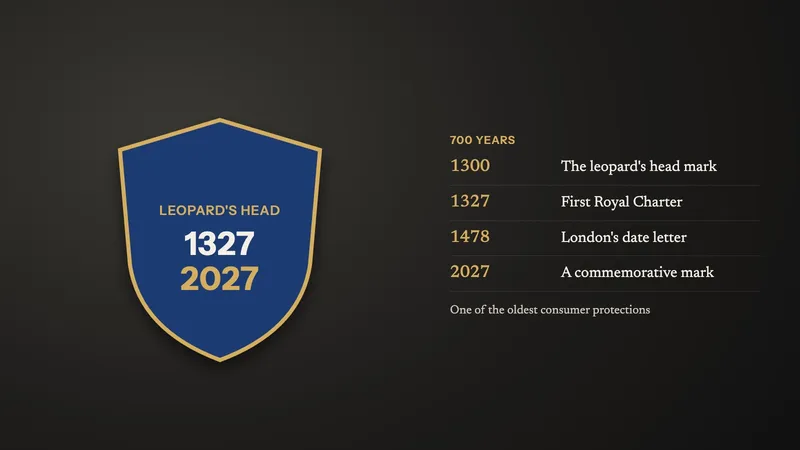
The Goldsmiths' Company in London received its first Royal Charter in 1327, and celebrates its 700th anniversary in 2027 with a year-long public programme, "Treasuring Brilliance". In November 2026 its London Assay Office unveiled a special leopard's head commemorative mark for the anniversary; proceeds from applying it go to two jewellery trade charities.
How hallmarking began
- 1300. A statute of Edward I required silver to be of the sterling standard and marked with the leopard's head before sale: England's first hallmark.
- 1363. Every maker had to add his own mark.
- 1478. London introduced a date letter, so the year of assay can still be read today.
- 1973. The Hallmarking Act set today's UK rules: items above small exemption weights must be hallmarked by an assay office before they are sold as gold, silver, platinum or palladium.
Hallmarks in the main markets today
- United Kingdom: compulsory, by one of four assay offices.
- India: compulsory BIS hallmarking of gold jewellery, with a six-character HUID code for each piece.
- Italy: fineness in parts per thousand and the maker's identification mark on every piece.
- United States: no compulsory hallmark; a karat stamp, if used, must be accurate and come with a registered trademark.
- China and Hong Kong: pure gold sold as 足金 (zu jin, at least 990).
Our hallmarking by country table compares the rules market by market.
Facts last checked: 15 November 2026.
Share this article
Sources
- The Goldsmiths' Company: Leading with the leopard, ahead of the 700th anniversary
- Retail Jeweller: London Assay Office unveils commemorative mark for the 700th anniversary (13 November 2026)
- Retail Jeweller: Goldsmiths' Company unveils year-long programme (6 November 2026)
- UK Government: Hallmarking in the UK, consumer protection